Leg 8
Massachusetts
to Indiana
Or
Fall Colors on
Steroids
Part 1
October 1-6,
2012

Monday-Tuesday
October 1-2
Massachusetts
During the ride from DC to Boston, the last leg, my Beemer’s
brake failure warning light kept coming on and then going off once I was on the
road with engine warmed up. My diagnosis was low brake fluid except the visual
window on the fluid reservoir showed it full. I had no brake failure problems,
but the light kept coming on more often and staying on longer, so I resolved to
have it checked out and if necessary repaired before I started off again. With
me in Indiana and the bike in Massachusetts, the problem became finding a BMW
shop that was open on Mondays so I could fly in on the weekend in order to get
on the road early in the week. I tried several shops, all open only
Tuesday-Saturday, until at last I struck gold at GBM Motor Sports in Arlington
Heights-Cambridge. I called them as soon as they were open Monday morning. Yes, they would look at the bike right away,
so I wended my way down Route 2 as quickly as I could in morning traffic. With
luck, I would get the repairs done today and be on my way Tuesday morning.
Not so much luck. Good news and bad news. The brake problem
was just as I had suspected, low brake fluid. Although I had checked the
reservoir window as instructed in the Owner’s Manual, it turns out there are two brake fluid reservoirs on this year
and model of BMW. For some unfathomable Teutonic reason, the Owner’s Manual
keeps the second one a carefully guarded secret. The bad news was that on the
test run, the mechanic noticed my clutch was slipping, which I had noticed
before but had not thought much about. However, the mechanic expressed concern
that I would not make it back to Indiana with the clutch in that condition. Repairing
a clutch on a BMW is a very involved disassembly and assembly process, read
expensive. Hmm, start off into the wilderness of Maine and the Adirondacks with
no BMW shop for hundreds of miles, or get my clutch fixed now? Not really much
of a choice. The shop did not have all the parts in stock, but if I gave the go
ahead now they could have them overnighted by Federal Express, they should be
here in the morning and I could be on my way by mid-afternoon.
Go ahead.
I caught a bus down to Porter Square for some lunch and to
catch the Fitchburg commuter rail line out to South Acton at 1:30, where my
sister-in-law would pick me up. All around Arlington Heights, I passed small
road construction sites where road crews were doing repairs, either repaving or
doing something down in the sewer. Every single repair site was staffed by a
policeman, who pretty much just stood around. Funny, we don’t need policemen at
every small road construction site in Indiana. Apparently in Massachusetts these
sites are big crime scenes! Not. Unions. I’m sure union work rules require the
presence of a cop to direct traffic. Ridiculous. No wonder they call the state
Taxachusetts.
Not my problem. I found a good Thai place for lunch, and picked
up a very fine bottle of Laphroaig as a gift to my brother-in-law to thank him
for putting me up. The commuter rail was right on time,
but while waiting at
West Acton “station” I noticed this mini “city scape” that eclipsed the autumn
leaves for color:

Back at the ranch, after sharing several wee drams with my
brolaw, and taking everybody out to dinner 11 o’clock the next day found me back
at GBM. Yes, the parts had come in. The bike was on the lift and in the
beginning stages of disassembly. It was going to be a while, so what to do? I
walked a few blocks to Sarah’s Barber Shop (which I had passed the day before)
to get my locks trimmed. Sarah has owned and operated her own shop for several
years, telling me very clearly that she had a barber’s license, not a beautician’s
license, cutting men’s hair only – Shampoo in reverse! It was fun to have a
barber was dressed like a babe, heck she was a babe, obviously Sarah knew her
clientele. The haircut cost me double what it would in Indiana with my old guy
barber, but she was good and I certainly didn’t begrudge it. Sarah is a
hardworking entrepreneur who has found a way to make it on her own. She told me
she averaged about 20 cuts per day. Do the math, guessing 20 minutes a customer
that’s a full day on your feet and clipping shears with not much time to sweep
the floor, open and close, do the books a or take a break. I wonder if barbers
are prone to carpal tunnel syndrome? Anyway, everything is more expensive in
Massachusetts than Indiana, right?
Maybe not. After Sarah’s, I strolled down the street to grab
a “grinder” at a local deli-grocery store that featured a steady stream of
local workmen obviously coming in for their daily feed. The line was a great
advertisement. Excellent - but I also thought the grinder was pretty expensive,
chalked it up to Massachusetts prices again! My apologies to the deli, not so. Sometime
later, I stopped at a Subway chain back in the Midwest for a $5 6-inch sub and
“made it a meal.” The clerk said, “$8.03!” I said, “It’s a 6 inch, not a foot long.”
She had apparently heard this reaction before, and apologized as she assured me
that was the price of the “meal.” Wait a minute, $3 for a pour-your-own soda
and a measly bag of chips? What’s going on here? Inflation, that’s what. The
smart marketeers lure you in with the inexpensive sandwich and hit you with the
extras that you don’t think about. The BLS says inflation this year is at about
2%, and the USDA projects retail food prices to rise by 4-5% in the coming year
due to the drought in the rising energy prices, but the people on the street
who have to buy things everyday know from their own experience that these
government numbers are BS. It’s hard to get out of a McDonalds these days for
less than $8! Britain just reported that their food prices have risen more than
30% since the beginning of the fiscal crisis in 2009. That sounds more like the
truth of the situation in the US. The truth is that the purchasing power of the
dollar today is in free fall, which gives me concern as I join the ranks of the
semi-fixed incomes. Not much I can do
about it today, though.
Back at the shop, I couldn’t see much progress on the bike. The
weather kept deteriorating as the day dragged on, getting colder and looking
more and more like rain. I became more and more fidgety – but what to do? so I
spent a lot of time in the “boutique” stocked with helmets, gloves, jackets,
after-market parts, motorcycle electronics, etc. I considered a very nice pair
of new leather gloves, but $70 (!) was too much on top of the clutch repairs. I
did buy a balaclava (an over-the-head full face mask). The shop guy swore buy
it, he wears it ice riding during the winter (crazy man!) to protect against
the freezing wind. Looking outside, I decided it made sense where I was headed
even if it did make me look like a terrorist! The shop guy also told me if I
was driving through Vermont near Quechee Gorge, I had to stop at the Quechee Diner, the food is awesome!
For a while I watched some of films of races at the Isle of
Man TT which whetted my appetite to go there next May. 3 o’clock came and went.
I could see the bike was finally being reassembled but it was far from done. I
inspected almost every motorcycle on the floor to see what was au courant. 4 o’clock
came and went. It was way past mid-afternoon, and it was beginning to mist
outside as afternoon traffic began to thicken. Let’s just say I was not happy,
but I never complained. They were doing me a favor, and bitching wouldn’t make
things go any faster. I gave up watching the pot boil and for a while sat on
some steps leaning against my pile of gear, reading a novel on my Nook. Bored
with that, I went back into the service shop to watch the reassembly process. The
shop didn’t close until 7. I began to wonder if I was really going to get out
of Boston tonight. Sometime after 5, the mechanic lowered the bike off the
lift, backed it out of the shop and put on his helmet and riding gear for a
test drive. When he came back he pronounced that it “felt good.” He apologized
for being so slow, and of course I said I’d rather have it done right than done
fast. A seal had broken that allowed engine oil to leak into the transmission
which in turn got the clutch plates wet and was causing the failure. He had no
explanation as to why, didn’t see how it had anything to do with the way I
might ride the bike. For those of you who think BMWs are all super reliable,
this is the second clutch I have had to replace for the exactly same reason in
7 years, the last one at least was under warranty. The mechanic offered that I
was not the only one, he had replaced 3 (!) on another fellow’s K1200, perhaps
there is some kind of design problem with this model.
A plug for at GBM – everybody I met there was helpful,
knowledgeable, friendly and, well, just great. I trust their integrity and
ability implicitly, and I do not hesitate to highly recommend the shop. From my
conversations there, they actually have a similar underground national
reputation. Terrific shop.
In any event, having contributed greatly to the local economy,
by 6 I had my bike packed up and was heading up a wet Route 3 to Interstate 95 in
a light drizzle. The first minutes of any rain lifts oils off the pavement and
makes it quite slick, which you are aware of much more on two wheels rather
than four, so in a way I was thankful for the congestion of heavy traffic that
kept the speeds down as I crept along the north side of Boston. All the day’s
delays killed my plan to leisurely explore the North Shore and feast on fried
full belly clams at Ipswich. My objective now was just to get at least as far
as Portsmouth, New Hampshire as quickly as I could, to cut down the distance I
would have to drive to Bar Harbor the next day - which meant as soon as the
Interstate turned northward and the commuter traffic dispersed after Danvers, driving
very, very fast on a very wet roadway, zipping around 14 wheelers like a bird
flitting amongst a herd of cattle The heavy cloud cover made it hard to gauge
the time, it seemed as if twilight lasted for hours, but even the half-light
and the road spray could not obscure the colors of the leaves parading both
sides of the road. It was eerie. Huge gray granite boulders sitting on the road’s
shoulders like giant chunks of smoldering coal, crested by waving red and
yellow flames with the road mist rising all around like smoke against the
darkening slate gray sky. Followed by no moon, no stars, no streetlights, just
a world hurtling by at 80mph gradually descending into utter blackness in smoke
and flames…
But by 8, I made it Portsmouth, and thankfully found a room
on my first try at a new Homewood Suites, staffed by more very friendly and
helpful people who gave me warm chocolate chip cookies! All of which goes to
prove that nice people and attitude can make what amounts to pretty much of a
disaster day pretty pleasant!
Sign of the day: hand scrawled in large print and taped to
the garbage can between the gas pumps at the station where I stopped for
gasoline in Arlington Heights: “NO DOG DROPPINGS” Ahh, the joys of urban
living! Woof!
But what may be the sign of the month is jarring Regardless of your politics or party affiliation
or lack thereof, this sign is reflects what is going on throughout the country
less than one month before the Presidential election. Reactions to this
billboard run the gamut from shock to outrage to laughter to celebration. It is
right up there with tv ad of the little blonde girl picking daisies in front of
a mushroom cloud in the 1964 Johnson-Goldwater campaign, but overall, this campaign
is even nastier – and longer. Only worse. The 1964 ad carried a message of fear
and dangerous judgment. This billboard is a message of loathing and deliberate
evil. This is without a doubt the nastiest election campaign I have ever seen
in my lifetime; little serious discussion about specific policies and plans for
the future, just platitudes and promises without substance, many vicious
attacks against candidates at all levels, and often blatant lies. The country
is deeply divided. People on each
side despise the other’s policies and candidates. Gone are the days when people complained there was no real difference between Nixon and
Kennedy. It is not just a sign of the day, it’s a sign of the times.

Wednesday, October 3
New Hampshire – Maine
Headlines over coffee in the early morning: The Bureau of Labor
Statistics reports that people looking for work had dropped from 8.2% to 7.8%
in one month! “How can this be?” I ask myself, when at the very same time it is
reported that the economy has grown more slowly in 2012 than in 2011 for two or
three consecutive quarters? Does that make sense to you?
Well, it didn’t to me, so I did a little quick research. Not
surprisingly It turns out that the devil is in the details. Leaving aside that
the first report of the BLS employment statistics is an “estimate” that is
always “revised” a few months later (which in this case will be after the
election, is my cynicism too apparent?), I found that this measure of
“unemployment” (called the “U3”) does not measure unemployment at all: it
measures the number of people actively looking for work. Observe the
difference. I’m not sure what methodology they use to calculate those actively
looking for work, but assuming that
it is consistent and consistently applied, this data point:
·
Does not count those who have given up and stopped
looking for work, almost universally estimated at over 8 million people;
·
Does count as those who are involuntarily
part-time employed as “employed” and therefore not looking for work, also
almost universally estimated to be another over
8 million people.
The estimated drop from 8.2% to 7.8% in this measure of people
actively looking for work is entirely at category, and therefore “no
longer looking for work.” There is another BLS statistic calculated at the same
time but less widely reported called the “U6.” The U6 only counts 1/3 of those who have given up
looking, which results in an “unemployment” figure of almost 15% and, the
U6 has not dropped. Neither the U3 nor the U6 includes the more than 8
million who the statisticians agree have given up looking for work. If you
include all of them, the rate of “underemployment” and “unemployment” is almost
22%! Or is it 25%, I forget! Either way, over 20% is a depression level of
unemployment that apparently nobody in either party wants to talk about.
Another perplexing statistic: retail gas prices are stuck high
around $4/gallon, while due to the worldwide recession the price of crude has
fallen 38% from $147/barrel to $92/barrel. So why is the price gas at the pump
as high or higher as it was when crude was at $147/barrel? Some claim it is the
rapacious oil companies keeping gasoline prices high with artificial shortages
in order to rake in record profits. This presumes a price fixing cartel, as no
single oil company has anything like that kind of market power. However, I
simply can’t conceive of oil executives being sop stupid as to risk the
criminal penalties of an illegal price fixing cartel, especially under the
aegis of this anti-fossil fuel administration. Plus there is this inconvenient
factoid: this year US refineries have been operating at 88%-91% efficiency,
which allowing for maintenance and breakdowns is virtually 100% capacity: the
refineries are simply not being shut down to create artificial shortages to
justify high prices. So why else might prices at the pump remain high while the
cost of crude drops? Well, we all know that prices tend to get sticky going
down. Nobody wants to be the first to lower their prices when costs drop, so it
usually takes longer for the market to reflect decreased costs than it does to
reflect increased costs. But that doesn’t adequately explain why this phenomena
has lasted as long as it has. Something else must be going on. Here’s another
interesting factoid: much of the profits of US big oil are coming from
petroleum exports, that’s right,
exporting US gasoline to foreign markets is actually more profitable than
selling that gasoline in the US. How can that be? Gasoline is a worldwide
commodity market, the price being pretty much the same everywhere. Well, that
may be true, but profits are determined by the simple formula of price less
cost. Costs are not the same
everywhere, so profits are not the same in every market at the same price. The
US is a higher cost market than foreign markets where US oil companies are
exporting. Why? Simple, Virginia. Regulations.
Let me give you an example of which I have personal
knowledge. Back in the 80’s, when the US EPA ion its infinite wisdom banned
tetra-ethyl lead (leaded gas), leaded gas was still in high demand overseas
because it allowed engines to get higher fuel mileage, to run on less refined
grades of gasoline, and at the same time extended engine life – the very reason
that lead was added to gasoline. Less refined grades of gasoline also means it
is cheaper and easier to produce in the refinery. So while the market for
leaded gas, and thereby cheaper less refined grades of gas, was legislatively
abolished here in the US, it thrived overseas. Not only that, but market
division cartels affecting non-US markets are not illegal in the US. So, the
two major world producers of tetra-ethyl lead collaborated, one shutting down
its refineries and transferring all of its demand to the refineries of its
“competitor,” which made the remaining refineries highly efficient and
accordingly, the tetra-ethyl lead much cheaper to produce, while the other
producer tuned over all of its delivery
tankers and stations to its competitor, allowing ships to be put out of
commission as they aged and eliminating duplicative routes and storage stations
The two “competitors” presented one price of tetra-ethyl and reaped record
profits from drastically reduced costs in the years after tera-ethyl lead was
outlawed in the US.
How does that apply to the price of retail gasoline today?
Factoid: EPA regulations require regional and seasonal “blends” of gasoline that
both cause refinery inefficiencies and prevent a national US market for
gasoline. Gas being made in California can’t be shipped and sold to
Massachusetts because it is the wrong blend at the wrong time of year. I was
curious as to exactly how many of these different mandated blends there are.
Surprisingly, I found that it was virtually impossible for me to find out! You
can’t find number of blends mandated anywhere on EPA website. After reading
several articles, I also could not find any consensus on the number of blends
being used in US – estimates ranged from a low of 45 to a high in the 100s! It
is abundantly clear that there are different blend mandated for every major
city, different seasonal blends and other blends for special “sensitive”
non-populated areas. The EPA says all these blends only adds about 2-4 cents to
the cost of a gallon of gas, but anybody who has been in the refinery business
recognizes that as patent nonsense. Possibly that might cover just the extra
direct refining cost per gallon, but what about the total indirect costs of
limited production runs, change overs, seasonal changes, the inability to ship
to national markets or to relieve shortages, inefficiencies in distribution, special
costs at pumps to recover emissions, special additives to oxygenate blends,
costs of ethanol, capital costs of new equipment, and the occasional
extraordinary cost of running afoul of the associated regulations (the EPA once
attempted to assess a fine of $656,000 on my company for an activity that the
Michigan DNR had twice specifically approved under the exact same regulation;
at a 10% margin it takes roughly $7,000,000 in sales to cover that kind of
fine, not counting legal and PR costs – but that’s a different story) are much
higher than the EPA estimate. In fact, it would appear that they are higher
than the cost of exporting that fuel! Why else would we be importing crude and
exporting gasoline?
So, if you are an oil company executive, and it’s cheaper
(and therefore more profitable) to ship and sell less refined gasoline to
markets outside the country where EPA regulations do not apply, what would you
do? Even if it does cause occasional shortages and higher prices in the
domestic market?
This is all good for all the green weenies in the Obummer
administration because the different blends supposedly protect or improve the
environment, and all the associated costs make the higher price of gasoline a disincentive
to the use of fossil fuels and an incentive for “renewable” wind, solar and
hydro - and if in the process the oil companies make record profits, they are
the perfect fall guys for high gasoline prices. But these blends are also why
we will not see an increase in refinery or distribution efficiency, or again
see a truly national US market for gasoline, all of which would decrease the
price of gas at the pump (which incidentally could also easily be accomplished
by decreasing the regressive state sales taxes imposed on every gallon of gas
sold). Of course, if you are an urbanite who believes with almost religious
fervor in the imminent disaster of man-caused global warming, this should also be
very ok with you because the net economic effect is to discourage use of fossil
fuels and you don’t drive a car much, anyway. But if you are a redneck living
in the boonies, this is not good at all, because there you actually have to use
your vehicle to get around, and this makes day to day living much more
expensive. Of course, the higher price of gas also affects urbanites in less
direct ways, as the higher costs of fuel add to the to the cost of distribution
of goods that urbanites must import from their country cousins, but people are
not as aware of that creeping cost the way you are when you are confronted with
the prices at the gas pump several times a month. And when our government
reports inflation, it excludes the costs of fuel and food – can you believe
that? Two of the items that are most subject to inflationary pressures and that
most directly impact most people are excluded from the inflation rate
calculation. While the government tells us that the inflation rate is below 3%,
the cost of filling your grocery cart has actually gone up about 30%. True.
Connect the dots, Virginia: the price of crude has much less
to do with why it costs $100 to fill the tank of your car today than you think.
Eventually of course, the inexorable laws of economics will prevail. Barring
war, the price of crude will stay down due to decreased demand as long as the
worldwide recession continues, and competition will tend to bring the price of
gas down somewhat at the pump. But don’t hold your breath waiting for the “good
old days” of $2/gallon gasoline under today’s government policies. Not gonna
happen, no way, Jose.
Too much thinking for one morning’s cup of coffee to handle!
I have read that downtown Portsmouth is the gem of New Hampshire’s 18 mile sea
coast, retaining “the grandeur of its 18th century maritime
heyday,” so I am resolved to explore it
before I head off into Maine. Good move! The commercial center is full of shops
and taverns (which I neglected to explore the night before, bad decision), and
borders Prescott Park and the Strawberry Banke. These are truly worth a visit.
As usual, I was there before they opened, but I was able to stroll the area at
my leisure without interference. Lovely. If you were part of the upper classes,
living in olde new Englande was clearly a very good way of life –


Tempis fugit. The sky was grey and pregnant with rain, but I
was hopeful that it might hold off enough that I could stay ahead of it as I
headed further north along the coast.
Not. Heading up 95, the skies opened up around Ogunquit.
With rain beading and road spray beading on the windshield, and rivulets on my
facemask obscuring my vision, and gust of wind buffeting me across my lane, I
had to slow down. This is turn reduced the effectiveness of the wind blowing
over my windshield as a rain break, resulting in more cold water falling on me.
Chaps are a pretty good defense against rain and road spray, but they have no
crotch – so when the windshield airfoil fails, a certain part of you anatomy
gets very wet – and very cold. Quite an odd sensation, actually, as everything
around it protected by the chaps remained fairly warm and dry.
I took the first exit I could, and naturally, there were no
services at the exit. They were several miles toward the coast, deeper into the
storm. I was sodden by the time I pulled up to the convenience store and gas
station at the first intersection. A friendly young guy held the door open and
expressed sympathy for my plight, saying that the day before it had been
beautiful and the rains had just started this morning. Oh, well. I took my time
in the blessed dry warmth of the inside as I (literally) dripped on the floor
and wrung the water out of my leather gloves, drinking hot chocolate and
munching on a piece of pepperoni pizza in an attempt to warm up and wait out
the weather, hoping the rain would abate. It did start top break, so I went
outside to fill up my gas tank. Crazy. When I pulled in, there wasn’t a single
vehicle at any of the dozen or so pumps. When I went out to fill up, at least
half of them were empty. By the time I
got the bike started and backed up, all 12 were full! And of course, while
waiting for one of the to open up, the
rain started again. By the time I got under the canopy to fill up, I was once
again soaked. A fellow with a big white beard filling his SUV at the same pump
chuckled, “I can’t tell you how many times I have been where you are now! I
just sold my 1984 Gold Wing with 198,000 miles on it,” he proudly announced.
Just sold and already he missed it, wanted to reminisce about years of riding. “I
have to ask, where you traveling from and to?” I told I was from Indiana and I
had come from there via Key West, and was going back via Maine and Vermont.
“Wow,” he said, “I thought I was doing something riding 300 miles a day, but
that’s real riding!” I didn’t pop his bubble (or my image as an iron butt) by
pointing out that I hadn’t done it all in one stretch. J Oh, well!
I waited inside again until the rains let up, but finally
decided I had to go if I was going to have any chance of seeing Pemaquid and
still make it to Bar Harbor by nightfall. I said goodbye to the cute girl behind the cash register who volunteers that if she didn’t have to work, she would
ride to Bar Harbor with me – oh, well!
A few exits up, I detoured to ride Routes 1 and 9 along the
coast through Kennebunk. Never have I seen so many antique shops, anywhere! And
for every two antique shops, there was some sort of artists gallery, paintings
or pottery. And the closer I rode to Kennebunkport, the more Obama-Biden signs
I saw. Scads of them, sometimes two or three to a yard, lke falling leaves,
everywhere. It seemed to me to be an in-your-face to the Bush family, all the
Obama supporters showing their colors in this community most famous as the Bush
summer residence. Even the guide book got in its licks: “That grand estate overlooking
the ocean on the right – the one with the unwelcoming security gate –is Walkers
Point, summer abode of former President George Bush.” Wow, that’s harsh. With neighbors like these, he
probably needs that security gate! If this is any indication of how the rest of
Maine feels, the election will be a landslide for Obummer. One thing I did
learn, though, too late to take advantage of it, is that Kennebunk is a real
hotbed for Zumba Classes. I really should have taken one while I was passing
through! J
Oh, well! Kennebunkport itself was quaint and pretty, but overall I have to say
I was a little disappointed by this detour, not as pretty a ride as advertised
I really wanted to see Pequamid because my ancestors wrecked
there during a storm when they arrived in the New World in 1635, on a ship
named the Angel Gabriel. I am told there is a historical marker at the spot
where they waded ashore, and there is a museum with relics from the wreck,
including a trunk from the ship donated to the museum by a distant cousin who
now lives in Colorado. How often can you experience history with such a direct
connection as that? So I made tracks for
Pequamid, turning off the main road at Damariscotta, population 1100. Very
pretty, very English, with shops and small hotels lining the street that rises
up from the harbor south toward Pequamid. The sun was breaking through and
there were beautiful views from the 27 down to the water, all looked good. But
the further south I went, the worse the weather became. Worse. And worse. Rain.
And wind. Rain drops stinging my cheeks like cold needles. As much as I wanted
to see Pequamid, I decided it was not worth getting totally soaked again, so I
turned around and went back to Damariscotta, out of the rain and headed east,
once again in the sun. Oh, well. Maybe another time. And, then again, maybe
not. There is less and less time for another time. But maybe…
Things got much better. I pulled
over at Captain’s Fresh Idea Restaurant, home of Wicked Good Lobster Rolls and Lobster Stew,
in Waldoboro. Oh, well. I had both. Amen, wicked good! I looked around, but I couldn’t see
anybody in a long sleeved blue and red striped shirt. This was the last week Captain’s would be
open before heading to Sarasota for the winter. They were kind enough to turn on the space
heater near my table so that I could dry out my gloves. Another biker was there, and of course we
struck up a conversation, he was heading south, too. It turns out that half the State of Maine must head
south after Columbus Day weekend! They
turned me on to a short cut to Camden through West
Rockport, and I was once again on my way.

At Bucksport, I
got to ride over the new suspension bridge across the Penobscot River.

Tremendous views,
and I suddenly realized I had recently read about this place. It was the scene of the largest
combined naval-army assault in the American Revolutionary War, where in the summer of 1779 a
much larger American force attempted to trap the British fleet and assaulted the town of Bucksport
held by 1000 Scots. The Americans failed, miserably. It was a complete British victory
that all but destroyed the Continental Navy. The famous Paul Revere commanded the artillery for
the Americans, and made a complete buffoon of himself. If you want to read about it, The
Fort by Bernard Cornwell is a terrific yarn! He describes it so well that
when standing on the
bluffs overlooking the town, you can see exactly how everything fell into
place.


I walked downtown
under gas streetlamps past Bar Harbor mansions that are now mostly bed and breakfasts or
oceanographic institutes of some kind or another, to West St. Café where I indulged in a
dry martini, lobster remoulade, and
(finally) those wonderful fried full belly clams for dinner before
hiking back to the Clefstone to slip under the covers next to the fire to watch the first
Presidential debate between OBummer and Romney. Not surprisingly, I was too
tired to watch it all, but
I stayed awake long enough to recognize the phoniness of forced friendliness when the rivals
greeted each other, and several bald faced lies mouthed sincerely as the absolute
truth. I was reminded of what my mother taught me, that manners are for people you don’t
like. Overall, I felt both candidates seemed overly coached, too stiff with
very little
spontaneity, but that Romney had come out on top. The next day, the political
pundits on both sides
universally reached the same conclusion, and that the election was now “game
on.”
As I drifted off
to sleep, for some reason it occurred to me that I had not seen a Walmart all
day! They do have Walmarts
in Maine, don’t they?
S.O.D. – Had to
be “Obama Biden.” Everywhere in Kennebunkport.
Thursday, October
4 -Maine
I was bound and determined to see Acadia before the rain
storm that had been chasing me up the
coast arrived, so as soon as I finished
breakfast as early as Cleftsone would serve it, I was on the Beemer heading up
to the top of Cadillac Mountain, listening to Huey Lewis and The News play The
Heart of Rock and Roll. At the top, magnificent views of the ocean and islands.
Life is good! While I was busy taking pictures, a fellow wandered over to my
bike, and walked around it, inspecting it from every angle like it was a rare
piece of art. Then he had his wife take his picture standing next to it! Man,
that guy really wanted a BMW motorcycle. I felt kind of sorry for him! Life’s
too short. I hope he was inspired to go out and buy one. As Oscar Wilde said,
“Take care of the luxuries, the necessities will take care of themselves.”

Looking out over the islands, I saw a cruise ship anchored
in Bar Harbor. It seemed incongruous, but they go everywhere now, Key West to
Acadia. Still, it seems that they provide a bumper sticker version of their
ports of call. Perfect for the ADD sound-bite generation!


Down the mountain grooving to the Sultans of Swing and admiring
deep forest green fir forests alternating with stands of golden capped white
birch trees when a partridge unexpectedly explodes from the undergrowth. Where
is my shot gun when I could really use it? Then out to Sand Beach. It reminded
me a lot of Drake’s Beach at Point Reyes in California. In fact, the coastline
reminded me of the Big Sur. I thought to myself, “Pretty lucky, I have stood on
the beach on both the Atlantic and Pacific Coasts, and been from Key West to
Canada in the past few years.” And a few year before that, I was scuttling
around like a crab with a cane because of a pinched nerve in my back and a worn
out hip joint, thinking I would never be able to ride a motorcycle or hike
again. By the way, did you know that hip replacement surgery is one of those
“elective” surgeries that would not be available to seniors under Obamacare?
Jesus, who would make rules like that except people who have not experienced
what a life changing operation that can be? Where does the impulse come from to
mandate what you can and cannot do with your own health and your own doctor?
This is insane.
Off to Thunder Hole . A busload of tourists all chattering
away in French arrived at the same time. After that, I sat on a bluff for a
while, watching mergansers (I think), flocks of what looked to be loons but
living on the ocean, surface diving for fish, and then over to Jordan Lake.
Even in cloudy weather, Acadia National Park is truly a treasure. I would like
to come back here in better weather and spend several days, because I really
saw so little! A perfect day would be to pack a breakfast and have it at dawn
on Cadillac Mountain, then actually go swimming at Sand Beach, and make sure to
schedule the day so that you are at Thunder Hole during the rising tide and can
experience the noises that give it its name, spend some time either hiking or
riding horses through the interior, and of course finished with lobster and
clams, and maybe the next day taking a boat out to whale watch. Ahhh, maybe
three days…


But today I wanted to get out ahead of that storm coming up
the coast, so by early afternoon I was headed out – stopping at Trenton for
another lobster roll, of course. There was construction right by the lobster shack where I intended to
stop. The flagman saw me, and turned his sign to stop traffic so that I could
cross and go in. He did the same thing when I came back out after eating. How
nice is that? I don’t know, it just seems to me that people everywhere along
this trip have been particularly friendly and nice because I’m on a bike. Maybe
it’s because I’m doing something they would really like to do? Or are they just
this nice to all travelers, and I haven’t noticed so much before?

I was sitting next to a family with two cute but really
restless little boys. They were becoming something of a nuisance, so the
proprietor(ess?) decide to help out. “We just got in our catch for the day, and
we have a five pound lobster. Would you like to see it?” Naturally, a chorus of
“yeahs” and they march out behind her, leaving the dining room for a few
minutes of blessed peace and quiet until they return, huge smiles plastered
across their faces, babbling about the giant lobster. “You should see it, Dad,
I touched it, a 10 pound lobster!” Hmm, wasn’t that a 5-pounder just a few
minutes ago? Grows with the telling. Nonplussed, their dad says, “Well you
really are a fisherman, aren’t you?” Ha!
Then as I drove into Ellsworth, I saw a Walmart! Walmart is
surprisingly controversial for such a successful retailer. Growing from a small
Arkansas store to a huge multi-national, it is blamed by many for destroying
the fabric of small town America by driving the “Mom and Pop” corner store out
of business.. Nobody was ever forced to buy at Walmart, yet virtually everybody
has shopped at Walmart. In fact, Walmart has vastly improved the lives of
millions of Americans by providing quality brand name products at the lowest
prices possible, and that’s exactly why it drove the higher cost, higher priced
corner stores out of business. And Walmart grievously wounded the likes of
Sears and Kmart while finishing what they started, the total transformation of
the balance of power in the retail goods distribution chain between
manufacturers and retailers. My old company, a home appliance manufacturer,
used to say, “The good news is, we now have Walmart as a customer. The bad news
is, we now have Walmart as a customer.” And now Walmart is doing the same thing
to (for?) eye care, pharmacies and walk in clinics that it did for clothing,
appliances and groceries. Walmart has provided all of its employees with good
quality benefits, as health insurance. Walmart has also hired the previously
unemployed, the “greeters” that some are so fond of ridiculing, who are for the
most part elderly whom nobody else would hire. So why is it so hated while the
others seem to get a pass? Yes, it created new jobs, in distribution and in
management, but for the most part the jobs it has created are fewer in number
and lower paying than those it has displaced.
And small business is romanticized in America, just like the family
farm. Walmart is is the prototype “Big Box” store after which are modeled Home
Depot, Lowe’s, Target and so many others that have relegated so many small
retailers to the ashbin. While Walmart has done nothing illegal, it has openly been
staunchly anti-union, and got itself into trouble with the trial lawyers for
its policy of refusing to settle what it considered nuisance “blackmail” suits.
But basically Walmart is reviled because it is the biggest, the most successful
big box store. So is Walmart good or bad? In today’s America, big and
successful increasingly seems to be bad.
My original plan was to drive to Calais and then into New
Brunswick, but I abandoned that when I abandoned my objective of getting to
Nova Scotia this trip. Besides, I left my passport at home, so now I couldn’t
cross the border even to visit Campobello, the international peace park on the
Canadian side of the border where Roosevelt spent his summers, a border that all
my life we have driven across with merely a wave at the checkpoint. Really, is
that really necessary to combat Osama and Al Qaeda? Combined with the possibility
that maybe inland I would more likely escape the rainstorm, I decided to change
routes and head north on 1A through Bangor and Orono. It was still dull grey
and I couldn’t see very far off the road, so I searched radio stations for
entertainment. I knew I had a winner when I heard Tequila Makes Her Clothes
Fall Off, followed by Miranda Lambert’s Fastest Girl in Town. I skirted
Phillips Lake through an area called Lucerne in Maine, which I suspect is
pretty nice but I can’t vouch for it! What I remember most were American flags that
suddenly appeared hung from every other telephone pole, on and on for miles and
miles, like it was a July 4th parade route, until I passed over a
township or county line where they abruptly stopped. Interesting. I kept
wondering, “Why all those flags?” Meanwhile, the big news on the radio was that
the Boston Red Sox had fired their manager, and that the mayor of Lewiston,
Maine refused to resign in face of a recall petition signed by a whopping 1,400
people because he criticized something that some Somali immigrants did, and
said something like “You are welcome to our culture but leave yours at the
door.” For some reason, this reminded me of the uproar when the owners of Chik
Fil-A expressed their opposition gay marriage, and activists attempted to shut
them down first with a boycott and then with a “kiss-in”, and Rahm Emmanuel,
mayor of Chicago pointedly refused to issue Chik Fil A a business permit to
operate their restaurants because they did not represent “our values.” Does it disturb you that holding the correct
political beliefs are now a measure of whether you get a license to operate a
restaurant in Chicago? It’s just not a good idea these days to voice any opinion
that is controversial, whether you are in public or private life. I remember in
the 60’s George Norman Rockwell, then the leader of the American Nazi Party
came with his “Storm Troopers” to make a speech in Ann Arbor. A few people
protested on the steps outside the auditorium, but they didn’t hassle anybody
coming or going. The auditorium was full. We listened to Rockwell’s nonsense,
and went home. We believed that everybody had the right to express themselves
in the public forum, and that in the war of ideas the best would prevail. That
was what fee speech was all about. That was the value of free and open
discourse. At the time, everybody I knew was revolted by what had been done to
those who spoke out against segregation in the South, and many of us had
unpopular things to say about the Vietnam War, so we were pretty sensitive to
the rights of people to say very unpopular things – to the point that antiwar
protestors actually were allowed to
collect blood for the Viet Cong on the Michigan Diagonal in the middle of campus.
Just a few years later, in 1968 I experienced the erosion of free speech first
hand when protestors with whom I sympathized took over the campus at Columbia
University. I’ll never forget sitting in class when the doors blew open and
several people came in shouting slogans, jumped up on the dais and walked on
top of the desks kicking all the books and papers to the floor, drowning out
the professor’s protests with their chants while the students sat transfixed in
shock. That was my first experience with mobs shouting bumper sticker slogans
to drown out any discourse with which they disagreed. Tolerance of free speech
has always been tenuous. From the very beginning of the Republic Congress
passed the Alien and Sedition Acts that outlawed criticism of the government,
and I bet many people would be surprised to learn (and even deny) that both
Abraham Lincoln and Franklin Roosevelt had their critics jailed. Regardless, I
don’t think George Lincoln Rockwell would have been treated with anywhere close
to the same degree of tolerance today as he was 40 years ago. At least the
actions in Lewiston and against the owners of Chik Fil A appear to have arisen
from the bottom, from the people, not the government, although the goal of
censorship is the same. But that’s a worrisome development, (successfully)
attempting to suppress free speech through
the government, either by trying to recall publicly elected officials for saying something that is not liked, or
inciting government officials like Rahm Emmanuel to exercise their government
power to indirectly retaliate to suppress thoughts with which they disagree.
Direct action or indirect involvement of the government, the intent and result
is the same: censorship. Are we seeing that deTocqueville right when he warned that
the tyranny of the majority in a democracy would enclose thought in that
“formidable fence” beyond which men would not go for fear of “all kinds of
unpleasantness in everyday persecution?”
I passed through Bangor just long enough to hurt myself. Leaning
into a corner on a hill. I somehow caught my foot between the road and a
footpeg, which gave it a heck of a yank, and in reaction I gave the bike a heck
of a lurch that almost dumped me. For a moment my ankle hurt like hell. “That’s
why I wear heavy boots,” I told myself, “People who ride motorcycles in flip
flops are nuts.” But right then I saw a tough Mainer walking down the street
with his shirt off in 40 degree weather. Brrr. I told myself to quit whining! By
the next day, the ankle didn’t hurt so much.
There are difficulties in taking the road less traveled in
the Days of Garmin that Robert Frost never imagined. New England roads, never
the easiest to follow because they tend to wander along streams and old cow
paths, and always notoriously not well marked, have become worse so as fewer
people travel them and fewer people pay attention to road signs. Strangers
seeking the fastest route from here to there take the Interstates. Those few who
actually get off the Interstate between here and there slavishly follow
directions of the toneless voice on their gps navigator, bing bing turn left
now. True locals don’t need to follow route signs. Ergo, in the priority
battles for slices of highway department budgets, route markings slip below to
filling potholes and snow removal. Repeatedly I rode for miles and miles
without seeing any route marker at all, often just guessing which way to go
according to the flow of traffic and condition of the road surface – sometimes
rightly, and sometimes wrongly. Case in point. Coming out of Bangor, I wished
to follow Route 2. Just North of town, the road divides. There actually is a
Route 2 sign at the intersection (not before it, why give any warning?),
partially obscured by untrimmed underbrush. Unfortunately, the arrow which is
below the Route 2 sign that tells you which way to go is completely obscured by that same untrimmed underbrush. Quite
obviously, nobody on the road crew or in the highway department management has
seen any need to trim those bushes for months, if not years. Of course, I bitch
because I took the wrong fork, and ended up on the Interstate instead of
backtracking to the fork in the road. I returned to Route 2 at the Orono exit,
which was quite well marked as most Interstate exits are. I followed Route 2 across
the river to Orono, intending to drive through the campus of the University of
Maine. Immediately across the river, the highway forked again. Route 2A went to
the left, but there were no markings as to what was to the right, and no signs as to which way the university lay. The traffic
was heavier to the right, so I went with the flow, thinking surely somewhere
there would be a sign to something indicating the U. There were no more road
signs of any kind for miles, to the point that I was wondering if I had drifted
off of Route 2 entirely when I found myself in Old Town, with 2A rejoining from
the left. I had managed to stay on Route 2, but I had completely circumvented
the University, which apparently is on Route 2A. Great. Oh well, I didn’t want
to see it bas enough to back track here, either.
Old Town is a hole. I don’t care if it is the legendary home
of Old Town canoes and kayaks, it is a hole. So is the next 20 or 30 miles on
the east bank of the Penobscot. Flat, wooded and dreary. There ain’t nothing
there, ceptin’ mebbe rednecks and critters. Probably big critters! I was back
in the land of the double-wides, and that was in the upscale neighborhoods. I
started counting the miles between intersections. I traveled 7 miles between
paved roads. I pulled back over to get Interstate at West Enfield and Howland,
looking for a place to spend the night. Nuttin’ except a road sign advertising
a Holiday Inn Express 30 some odd miles south in Bangor. That added insult to
injury. The road heading west to Milo and Dover looked equally bleak. Not good.
So I went into the general store with the gas pumps that was the only thing at
the intersection except a backwoods tavern that didn’t look open, and asked
where there might be some lodgings without backtracking all the way to elusive
Orono. The proprietress, friendly and helpful as usual, directed me further
North 12 or so miles to Lincoln, where there were no chain hotels but she
assured me there was an old privately run motel that was clean right downtown.
Lincoln is not a destination resort, unless you carry a 30
odd 6 during hunting season. One lap around the parking lot of the downtown
motel convinced me that I marginally liked the looks of the Notel Motel that I
had passed at the edge of town. I got a room there, last one on the ground
floor at the end of the building where the manager assured me it would be
quiet. Hey, there were beds, a couple of skinny white towels, a tiny no name
bottle of shampoo with no conditioner, and a giant antique TV that was as deep
as it was wide, all this and only $80! I’ll never complain about the ambience
of a Holiday Inn Express again! I couldn’t help thinking of the elevator
posters at the Hampton Inn where the kid marvels about how clean the beds are!
Oh, well! I turned on the heater and lay my gloves next to it to dry, took a
few hits on my trusty bottle of flavored
vodka, and everything looked better. It began to rain outside and I was dry.
All is good.
I turn on the TV to catch the news. It works! Turkey is invading Syria
to stop Syrians from shelling refugees in Turkey. Great. But there is a very
uplifting story about a family that rescued an injured crow. After they nursed
it back to health, they tried to set him free, but he has refused to go. He
keeps hanging around the house, and even follows the kids when they walk to
school, flying down to the playground to visit with them when they come out for
recess. Pretty neat!
After dark, I walked around the puddles to the Gilmor’s Beef
and Ale across the highway. That was
a hoppin’ place. It was mobbed, long tables filled with parties of twenty or
more people of all ages laughing and carrying on louder than heck. I took a
seat at the bar, the only place open. The bartender was a young guy with short
hair and a well-trimmed pussy bumper, with tattoos down his arms and bright
blue O rings inserted in his earlobes, so big that I could have stuck my index
finger through them and yanked if I’d a mind to. I couldn’t help thinking
“Ubangi!” He was a very friendly and very articulate guy. He first put the
rings in 8 years ago, and had steadily enlarged them. Art his suggestion, I
tried the local specialty on draft, Blueberry Ale. So good that I had two, I
think… And a shot (or two?) of Jack, too, I think. J The bartender obliged
me by yanking on his ear rings to show they didn’t hurt. I wonder if innovative
inserts like that might have a practical function on some body part? Probably
not…
As the night went on and the crowd kept changing and growing,
I found myself sitting next to a young Filipino woman. We struck up a
conversation. “How’d you get here?”
“My parents left the Philippines to escape martial law.” Interesting. According
to her, Ferdinand Marcos was a hero and a good governor when the Phillipines
first gained independence from the US, except he listened to his wife, Imelda of
the thousands of shoes, who came from a very poor background, was pretty much
crazy and ran the country into the ditch. Sounded to me a lot like Eva Peron, who
also came from a very poor background and married another dictator, who ran
Argentina into the ditch, not once but several times - only Eva was a leftist
and is lionized by lousy musical that has only one good song, while her soul-sister
Imelda is (rightly) vilified as just a crazy evil bitch. My Filpina said Aquino
(who was elected after they tossed Imelda out) was well intentioned, but
couldn’t pull the country together again because it was so in the tank and it is
spread too widely over too many islands sharply divided between Muslim and
Christian areas. Now, after kicking the US Navy of Subic Bay after Vietnam,
they are inviting the US back in?
Anybody who thinks backwater towns like Lincoln, Maine are
nothing more than collections of down and out ignorant rednecks and hayseeds
who do nothing but hunt and fish has another think coming. They may be right
about the hunting and fishing, but a bartender with bright blue earrings, craft
fruit flavored beers, and conversations about Asian politics with a Filipina
masters candidate? Hey, Gilmor’s in Lincoln is a happening place. But time to
pack it in before I get myself in real trouble!
S.O.D.: Route 2. Where is Waldo? MIA.
Friday, October 5 - Northern
Maine
When I awoke, I realized that I had miscalculated. I wasn’t
supposed to be in Lincoln today! By cutting North from Bar Harbor, I had gotten
a day ahead of my itinerary. I was supposed to be in Calais. Now I was going to
get to Rangeley Lakes a day ahead of schedule. So after breakfast featuring
homemade cinnamon toast at the Timbers, I called ahead to the Rangeley Lakes
B&B where I had a reservation for the next night to see if I could change
it to tonight. Luckily I could, because as much as I may have enjoyed Gilmor’s,
I didn’t particularly wish to spend another night at the Notel Motel. However,
this seemingly minor change in plans was to have unforeseen consequences down
the road!
As I was packing the bike to leave, I met my “neighbor”, who
was packing up his van, in his case
because he was going (where else?) to Orlando for the winter. He informed me that
in Florida, you absolutely needed to live in a gated community. OK, bro, if you
say so.
Leaving town, I espied the sign of the day. Maybe the sign
of the week:

Ben must do a big business in candles! I bet he could teach Sam
Walton a thing or two about low overhead!
As I rode through Enfield, I passed a small restaurant with
a big sign out front, “Still Serving Ice Cream and Good Food. Eat In or Take
Out.” Huh? Targeted marketing to locals in northern Maine well past summer when
everybody is heading south?
Except apparently me, now I’m heading west down 57 toward
Milo, following a long, winding and misty technicolor corridor of reds and
yellows with an occasional splash of stubborn green just for contrast, through the
land of mobile homes and hardscrabble lumbering. Every truck that passed left
the smell of fresh cut pine in their wakes. No lush farms here, although there
was place where you could buy Fresh Cukes 3/$1. Passed a sign that read “Blind
person.” Somebody had carefully added a 2 the beginning and an S at the end, so
it read “2 Blind Persons.” So we will be twice as careful, or what? Shortly
followed by another sign that read “Hidden Driveway.” Funny, I didn’t see
anything!
Until I got close to Milo, when a big flock of turkeys
emerged from the fog in a field by the side of the road. Beginning at Milo,
where three rivers come together, the land starts to have more definition to
it. Milo itself, population 1898, is dominated by a classic white steepled
United Church of Christ in the center of town, across from the ubiquitous
memorial to the Union civil war dead. It strikes me when I pass by The Pleasant
River Lumber Company, with logs and lumber stacked high just as in Georgia that
despite that history, these rural Mainers likely have a lot more in common with
rural Georgians than they do with the artsy-craftsy set along their own Maine coast.
I pass more and more farms, mostly livestock, and for the first time I see
houses directly connected to their barns, so that you can go from one to the
other in winter without venturing out into the harsh weather. (I have always
wondered why this innovation is pretty much limited to New England?) Piles of
chopped wood appear everywhere outside houses and trailer homes, some stacked
precisely just so and others just in haphazard tangled heaps where the logs
have been tossed, but either way a sure sign that winter is on its way. (Are
they really burning logs inside those trailers? Probably…)
Just past Milo, I stop to see a classic covered bridge
spanning the river. When I was growing up, I thought they only had these
bridges in places like Vermont and Maine, sort of like maple syrup. Then I
moved to Indiana and found a county west of Indianapolis known as covered
bridge country that boasts a dozen or more of them (and Hoosiers are equally
proud of their maple syrup, too!). Wherever they are, these bridges are minor
engineering marvels that evoke images of snow and horse drawn wagon in days
gone by.

The sun just began to break through the overcast clouds as I
took this photo looking up river from the bridge.

An older couple arrives there right after I do. They are
living proof that there is someone for everyone. He’s fat and white, she’s
dumpy and black, and they are immensely happy together. He’s from Texas, she’s
from here. I snapped some pictures of them at the bridge to take south for the
winter. That trip wouldn’t have happened 50 years ago. They tell me the bridge was
washed out in a flood in 1987, and rebuilt in 1990. Look at the picture, and
how far it is from the bridge to the water: that must have been one huge flood.
I wonder if the locals are still complaining about how Uncle Sam didn’t bail
them out, as they are in New Orleans a decade after Katrina? Somehow I think
not. Nobody is chopping wood for these people. They are independent. Rural
folk, not city dwellers. Beyond Milo, everything begins to look much more
prosperous. Maybe it’s just the sunshine making me delusional? No, it must be
more prosperous: I start seeing more and more Romney-Ryan signs. Listening to
Martina McBride sing Broken Wing reminds
me of the happy crow, and then I laugh out loud when the DJ asks “So, if
you choke a smurf, what color would it be?” Along the way, I pass some very
unique road signs:

In the Guilford river valley:

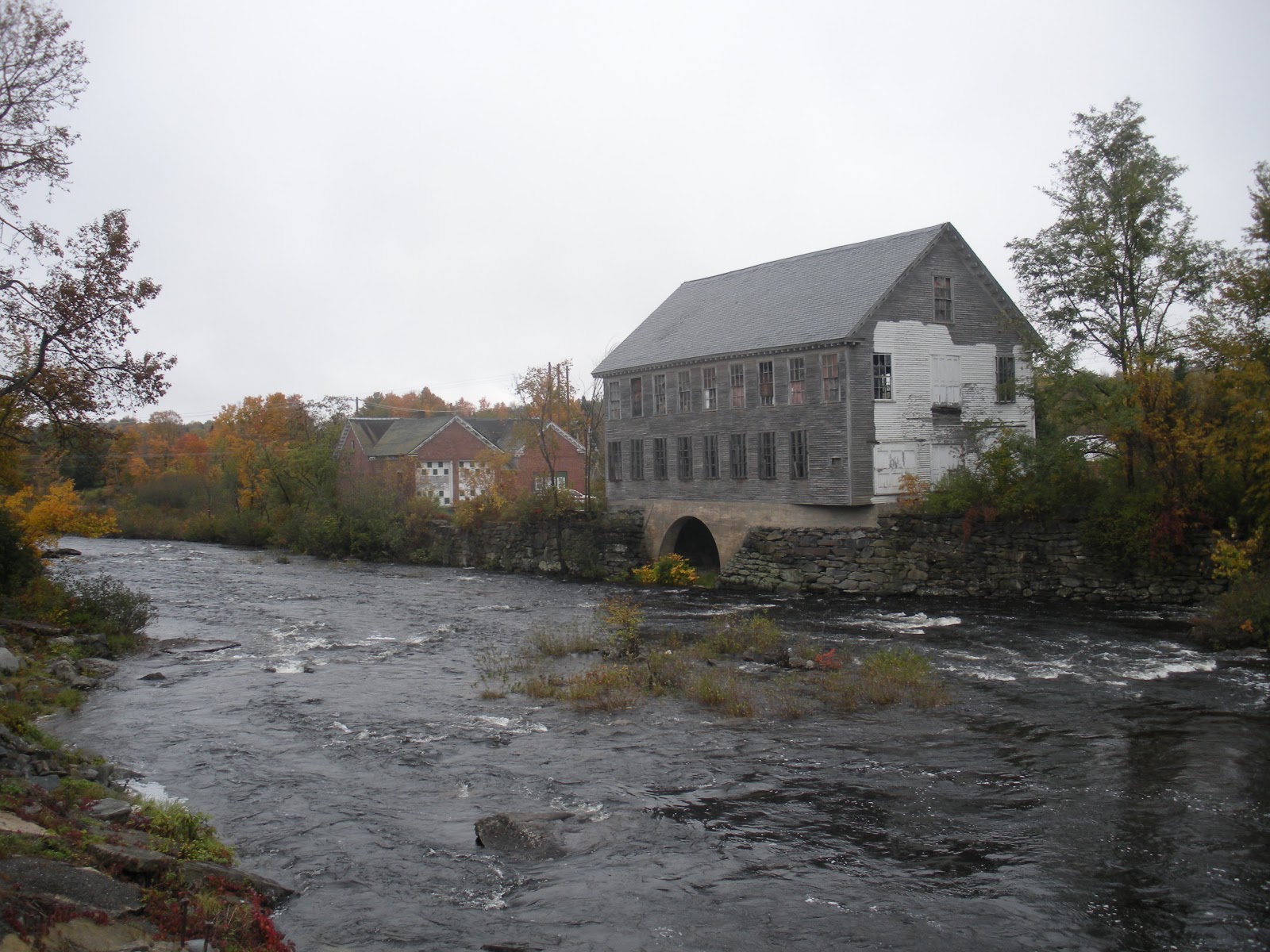
Pretty, but I am unprepared for when I arrive at the foot of
Moosehead Lake: I am blown away. I don’t know what I expected, but Moosehead Lake
is gorgeous.

I stop just outside of Moosehead to take another photo, at a
spot where there is no shoulder and a cluster of cabins hug the shore below me.
A group of people down there see me wandering back and forth trying to get a
shot, and wave me to come on down. I leave my bike precariously balanced by the
side of the road. They are setting up a tent for a wedding to be held there the
coming weekend. They show me all around, very proud of their place. What a view!

I thank them and say good bye, climb back up the hill to my
bike. Before even trying to get on it, I
brush against it while putting on my gloves it, just enough to disturb its delicate
balance and… it dumps! I manage to prevent it from sliding down the hill, but
at 800 ponds, there is no way I can right it. Before I know it, three or four
of the guys setting up the tent are next me to help pick it up. Of course, I’m
a bit embarrassed. Four of us right it, no problem, but to make things worse as
I turn around to thank them and shake their hands, the bike falls over again! It’s
pretty funny, and we all get a good laugh. I seem to always dump this damn bike
when it’s sitting still! (Of course, that’s a lot better than dumping when it’s
moving!) With a friendly wave, I’m off for Rangeley Lakes where I have a
reservation at a B&B.
I keep on 6 all the way to Jackman, where I am just 15 miles
from the Canadian border and a short drive to Montreal. I turn south on US 201
and follow what I learn is the “Old Canada Road, historically a big trade route
to Montreal and an immigration highway for French Canadians seeking jobs in the
US. Just after turning south, I come across the Attean Pond overlook, from
where you can see all the way into Canada (and all the informational plaques
are in both French and English!):

The Old Canada Road is fragrant with the smell of spruce and
alive with a brilliant kaleidoscope of yellow of maples mixed randomly with the
lemon green to rustic gold of turning birches, and slashed with white of sunlight
reflecting off birch bark. I pull over at Parlin Pond just to walk around and
soak it in. I neglect to remove my helmet, and as I walk down a trail to the
lake front, I startle a beagle who growls and barks at this strange booted
visitor from outer space invading his turf. And older fellow with a three day
beard and Boston Red Sox hat appears and calls him off. I take off the helmet
and make peace with the suspicious beagle by extending my hand for him to
smell, and strike up a conversation with the Red Sox fan. He has a camp across
the lake. He says there is fantastic fly fishing around here, especially since
they banned the four wheelers, which were really tearing up the woods. Fewer
and fewer people are hunting and fishing, too, so now you can once again take a
short hike in peace and quiet into some smaller lakes even at the lower
elevations, and catch plenty of wild trout. He loves the remoteness of this
place, but I get the impression he would genuinely welcome visitors who would
love it as much as he. I take note of a place called Bulldog Camp near Hackman
that might be just the sort of base camp for such a trip.

This sign is across the road from Parlin Pond, out here in
the middle of nowhere:

They feel differently here than does the artsy set around
Kennebunkport. (If you can’t see it, that’s the Constitution he is ripping into
shreds).
The Old Canada Road follows the Dead River straight south
into Maine, but proximity to the border and a warm welcome to Canucks is
evident. Where I stopped for lunch:

Rangeley Lakes Bed and Breakfast is very simple but passes
all the key B&B tests: clean; plenty of hot water; comfortable beds; a
fantastic breakfast; and an interesting host. “You won’t go away hungry,” the
owner says. He is a stout retired paper mill worker with a heavy Maine accent,
I think a widower. He says the B&B was his wife’s idea, but I see no
evidence of her being around. He’s not a cotton top who heads south for the
winter, he’s a year rounder. In fact, November (hunting season) and
January-February (snowmobilers) are some of his busiest months. December and
April (mud month) are his slowest. Yes, he has had moose meat. It’s good but not
as good as elk, which we agree is the best meat either of us have ever had. He
has hunted elk in the Colorado Rockies. We swap stories. I tell him of the time
when I was backpacking at 12,000 feet and had to take cover in some trees when
I found myself in the path of a herd of elk coming right at me. He tells me of
the bull moose that walked through his back yard and stood in the middle of the
road stopping traffic in front of his B&B the week before hunting season a
few years ago.
I finish the night drinking the last of my vodka from a
paper bag next to a “No Alcoholic Beverages” sign in the park, watching the
sunset before walking down Main Street to the Rangeley Inn for dinner.


I have fallen in love with Maine over the past few days. I
am reluctant to leave tomorrow.
Saturday, October 6
Maine to New
Hampshire
Over breakfast and hot coffee, newspaper headlines of the
new 7.8% unemployment figure leads to a discussion about the state of the
country among the innkeeper, some other guests from Michigan and me. Nobody at
the table believes that unemployment has really fallen below 8% for the first
time in 44 months the month before the election. It’s really disappointing when
statistics published by our own government are regarded with skepticism, or
even outright disbelief. The discussion turns to the docu-movie on Obama, 2016.
About half the people at the table have seen it, all agree it should be seen,
whether or not you agree with its conclusions. The newspaper also reports that
there was a shooting in the Lewiston version of the projects; I wonder if that
had anything to do with the Mayor’s comments on the Somalis, but the article
sheds no light on that.
None of the world’s problems having been solved, it’s
decision time for something I can control: do I stay in Rangeley Lakes another
night, or push on? I call ahead to the lodge at Blue Mountain Lake in the
Adirondacks where I have a reservation for Monday, to see if I can arrive a day
early and stay two nights. Yes, they would have to put me in a different room,
but I can. So next I try the Hampton Inn in White River Junction where I have a
room for Saturday night: can I switch that to tonight? No, I can’t, its
Columbus Day Weekend and they are all booked with leaf peekers. So I call back
the lodge at Blue Mountain and say forget it, I’ll arrive on Sunday as planned.
I decide to keep riding and find a place to stay somewhere along the way in New
Hampshire or Vermont, which should allow a couple of very leisurely day’s rides
through the White and Green mountains. So the chilly early morning finds me
continuing down Route 16 toward New Hampshire, passing signs that say “Moose
Antlers for Sale” and somewhat incongruously listening to Surfin’ Safari and
dreaming of the Endless Summer while looking at autumn colors against an
overcast sky. The electric guitars of BB King and Eric Clapton keep the rhythm
upbeat, and pretty soon I am mesmerized by the long double yellow lines of a
two lane highway that undulates like the curve of a woman’s flank from her
knees, over her hips, into her waist and back out again. I never have to change
out of 4th or brake, just point and lean with the road and adjust
the throttle. The background hum of the four cylinder engine enlarges to a
throaty growl when I decelerate coming into a steep grade and accelerate
through the curve at the bottom, drowning out the music. What election? I’m
probably smiling as I ride, but certainly before too long I am pushing the
envelope maybe a little too far, I get an occasional clutch in the groin like
riding the downhill side of a roller coaster when I think maybe I might be
coming too fast or at the wrong lean or trajectory into a curve – but it feels
really good when you come out of it!
I hit the border at the Magalloway River, and took this shot
looking across the valley to the White Mountains in New Hampshire:

And this of one of those connected barns at the Magalloway
River Farm:

As I got closer to Berlin, the countryside became more
pastoral. I drove through Flint Holsteins and man, could I smell them! And the
wind picked up, leaves blowing in the air and American flags flapping straight
out from their staffs, you could almost feel winter blowing in. Then into
Berlin, and old industrial town stuffed between granite ridges in a narrow
river valley, where I ran smack into generational differences. Stopped at an intersection,
a girl who looked to be in her late teens came running down the hill and around
the corner, barely breathing hard, striding like a fit young deer. It made me a
little nostalgic for when I had knees that worked as God intended and I could
run like that without them hurting. I pulled into a Dunkin Donuts across the
intersection to get something hot and to warm up. Inside were a half dozen
older locals sitting around like they might have done around the wood stove at
the local country store a century before,
swapping stories about old Saturday Night Live skits and remembering
Gilda Rattner and Baba Wawa. I’d rather have been running!
West of New Berlin, the landscape became increasingly rugged
as the road climbed into the mountains toward Crawford Notch. No more placid
farm valleys, these were rugged boulder strewn stream gouged gorges that
reminded me of the eastern slope of the Rockies, only here were stands of birch
rather than aspen. Several times I considered pulling over and checking into
one of the many motels or lodges that had vacancy signs, but I had not thought
to bring boots to hike in. Note to self: wear army boots, good for riding and
hiking! Besides, it seemed a little early yet, and the area was overrun with
busloads of Indian (red dot, not red feather) tourists and hikers at every
trail access, so I decided I would push on and find something on the other side
of the notch.
The Silver Cascade at Crawford Notch is awesome:


As I left the cascade, and crested the notch, the sun
disappeared and it began to mist. The further down the slope I rode, the
heavier it became. I stopped at a lodge across from Bretton Woods to see if I
could get a room. No Vacancy. Uh oh. The manager was kind enough to call
several other places on my way west. Nothing. A few turned into a dozen. No
luck. All the way to Littleton, one place only had a room and they had a 2
night minimum. Two other groups came in seeking shelter while I was there, were
turned away. Two choices: backtrack across the notch many miles to where there
had been vacancies, or continue on my way. I elected to push on, surely
something would turn up. The manager counseled staying off I93 South as there
was nothing but forest down the way all the way to Woodstock, she suggested
heading over toward Woodville.
So I cut across New Hampshire on secondary highways, at
first passing sign after sign that read “Happily Filled,” or “No Rooms
Tonight”, or simply, “No”, and then no more signs at all, enduring increasingly
cold rain and blustery winds on back roads covered with leaves that a few hours
ago were pretty in the wind but were now covering the pavement and
treacherously wet and slippery. The roads were narrow, twisty and humped for
rain runoff, not banked for vehicles, so I had to take them carefully and
slowly. I passed a place with gliders in the field and a fellow bringing in
saddles from the barn, but no room at the inn. Road signs? Useless. It was
drizzling too hard to look at a map and there was no cell phone service on the
back roads around Mt Mobislauke. As my only alternative, I tried to stick to
the more heavily trafficked roads on my theory that they would more likely lead
to a town large enough to have a hotel. I took the right hand turn at the center
of one small burg, got to the edge of town, turned around and rode all the way back
through it, nothing! Somehow I missed the turn to Woodville and found myself
near the Vermont border near North Haverhill. I took the first bridge across
the Connecticut River because I knew US Highway 5 lay on the other side, surely
there would be something there.
There was. A little country store. I stopped and asked if
there were any hotels, motels or B&B’s anywhere nearby. Only in Woodville
(!) which was back across the river and north. A very nice young girl trying to
be helpful began to give me impossibly complicated directions to a possible
place in Woodville, but I decided to let my fingers do the driving before
striking out again. At least they had cell service. Half a dozen calls later,
calling all the way to White River Junction and asking each place if they knew
of another place that might have a room, I found only one place, the Hanover
Inn at Dartmouth. One night there was more expensive than two nights at the
two-night minimum place I had turned down earlier, which I suspect is the only
reason they still had any rooms left. Literally, any port in a storm. I took it
before it was gone, too!
At least the weather gods showed some mercy. The rain
stopped while I was inside looking for a place to stay, and stayed away. The
doorman at the Hanover Inn fell in love with the bike. He loved BMWs. I gave
him a big tip to look after it for me, and somehow I ran him several times that
evening as I wandered around campus.
Each time he stopped to say hello and chat. Even with his suggestions as to
where to find something to do, it turned out to be one of the dullest Saturday
nights I have ever spent in a college town. The campus was pretty enough, but
nothing was going on. Even with a soccer game under the lights as
entertainment, Dartmouth was deserted. There were three types of people on the
streets: scruffy-looking pretend rebels (Real rebels at Dirtmouth? Give me a
break.); well-dressed preppy types; and geeky looking Asians (especially in the
library!), not many of any of them but by far more Asians than anything else. I
found a Chinese restaurant and sat across from a table of about 12 girls, 2
were black, two were very loud and obviously Jewish, one of whom was loudly
complaining that her boyfriend was in London with his husband – I kid you not.
Talk about confused! All were equally
unfortunate, and clearly could not find a date on Saturday night. Oh, boy. I turned my attention to an article in a
student newspaper highlighting the research of a professor on segregation in
America today. He found that there were virtually no all-white segregated
communities left, but that there were many very segregated all-black
communities. The article did not theorize the why behind that phenomenon, but I
suspect it is pretty simple: all people want to move up the socio-economic
strata, which in America meant blacks moving “up” into wealthier mainly white
communities, but few white people really want to move down the socio-economic
strata into mainly black communities. Wonder if I could get a government grant
to research that? But the article did get me to thinking about how many blacks I
saw (or didn’t see) in Hanover. Other than the two at dinner, one girl pulling
her jacket tightly to keep out the cold while hurrying across campus in high
heels. I didn’t see a single black male anywhere all night.
I stuck my head into a student play written by a student,
not well attended and it quickly became clear why: very amateurish. I found free
film that I thought looked interesting bring shown at the art museum, but it
was already more than 30 minutes in when I found the place, so I skipped it. I
tried to go see one of “the treasures of Dartmouth”, the Orozco masterpiece mural
described as the Epic of American History (perhaps better described as Cowboys
vs. Indians?) in the main library – and it was locked up for the night!
Wandering back across campus, through a fraternity window I could see 4 or 5
guys playing ping pong, with one girl hanging around looking bored. Whoopee!
Maybe there was some hope for them there, as another girl was walking up the
steps with a guy carrying a bottle of booze in a brown paper bag. I went back
downtown past what looked like a bar on the second floor where I could seem
more students playing ping pong. What is it with ping pong on Saturday night at
Dartmouth? Boring. At last I stumbled upon a place called the Salt Box Pub that
advertised blues music tonight. It was a mixed age crowd, with many of the
obligatory frizzy haired professor-types in their grey socks, Birkenstocks, and
shapeless smocks, and no free tables - so I ordered a Bass standing at the bar. Sensitized by the article, I
noticed that the only black students in the place were the ones wearing South
Carolina football helmets on TV. The band started up hopefully, with a barefoot
female singer who belted sort a sort of bluesy number that still set off
warning bells in my brain because it was like blues with an intellectual bent.
The trumpet and trombone player wore an old tuxedo with tails that I’m sure he
thought was very campy. The next few songs had nothing to do with the blues
although they described them as New Orleans style music. I decided that all the
members of the band were probably music school professors. I don’t know what
they were playing, but it wasn’t blues. Dull dull dull. Oh, I mean, really dull.

Could this be another confused Dartmouth student?
Or juts a gay terrorist?
Or maybe both?

Sign of the day: No Vacancy.
To be continued…


